


PINNGGG! Your phone buzzes demanding your attention.
A member of your church small group has asked for prayer - she is about to head into a round one job interview. Another member shares that their car has died on the way to a wedding of a close friend. Group members respond quickly indicating that they are praying. 🙏 emojis flood the group chat.
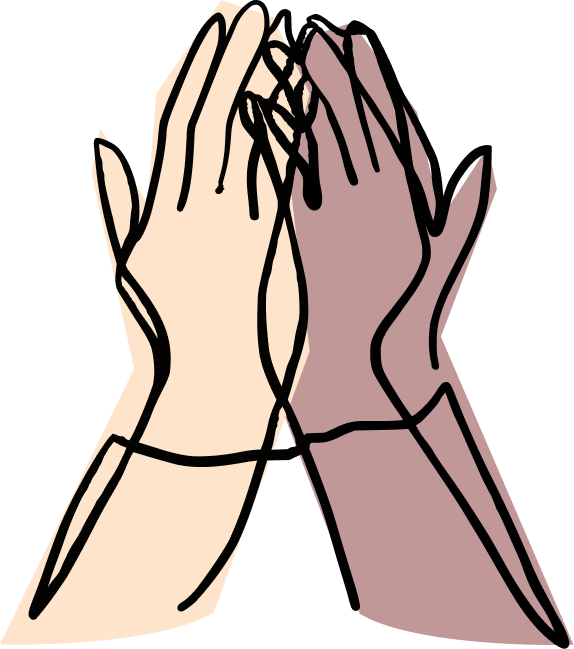
You’ve probably typed the Person with Folded Hands emoji 🙏 without thinking twice about it. It’s shorthand for please, thank you, for thoughts and prayers, or more rarely even a high-five. By Unicode’s own frequency data, it sits among the five most-used emoji in almost every English-speaking country — roughly one in every 30 emoji sent worldwide is this one.
But how did it emerge? The answer turns out to be stranger, older, and more theologically loaded than a yellow icon can communicate on its own.
From the Catacombs to Your Keyboard
Long before emojis there was a gesture for prayer — and for the first few centuries of the church, it wasn’t even the one we typically recognize.
The earliest Christians prayed standing, arms raised and spread, palms open toward heaven. It’s called the orans position — Latin for “one who prays” — and it’s everywhere in second-century Roman artwork but perfectly exemplified on the walls of catacombs like Priscilla and Callixtus, used to depict characters from the Bible like Noah, Abraham, Daniel, and countless nameless believers whose souls were pictured still praying from beyond the grave. The early theologian Tertullian, writing around A.D. 200, told Christians to pray exactly this way — arms outstretched, imitating Christ on the cross.
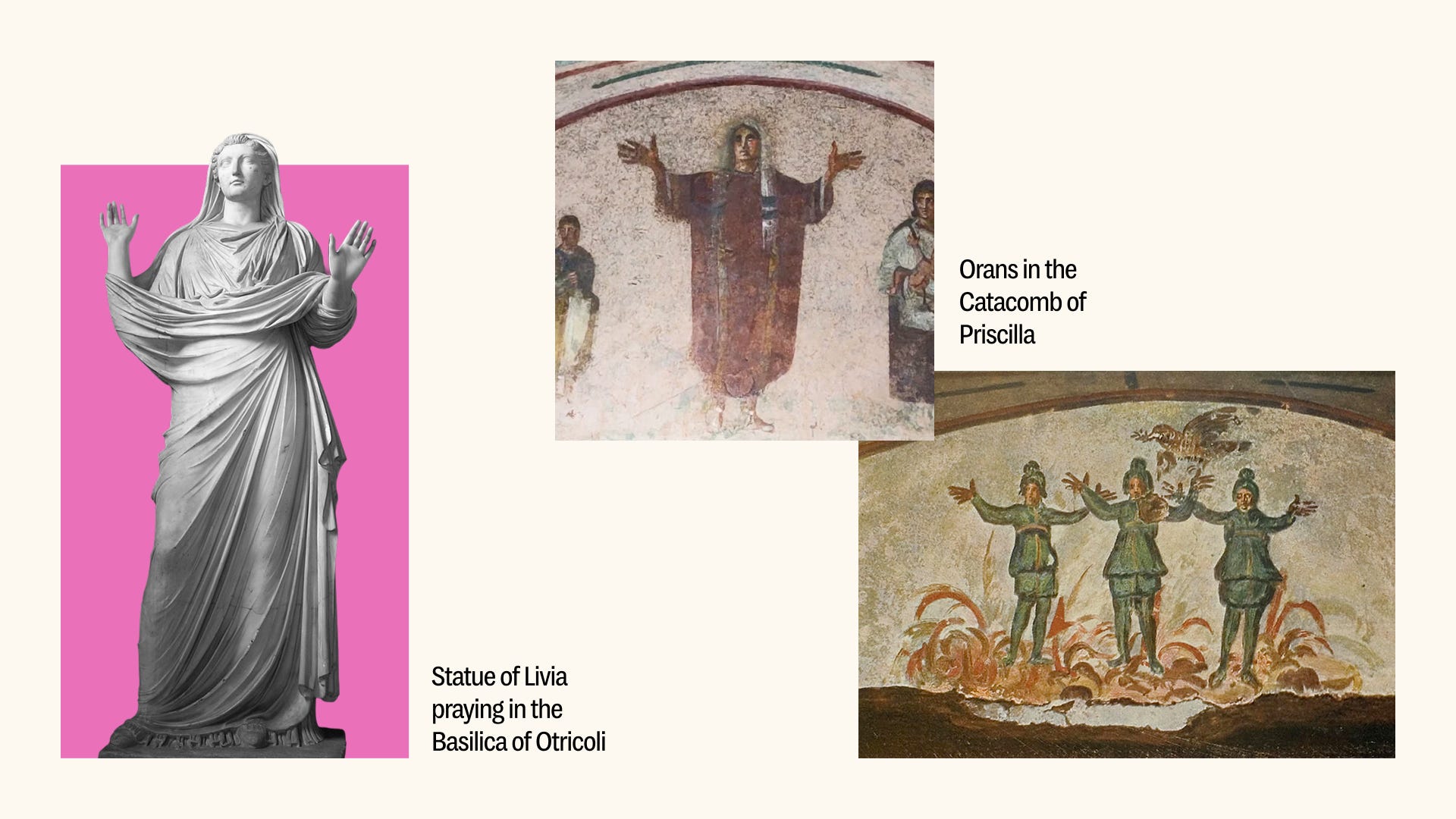
Folded hands, palm to palm, often accompanied with kneeling came later — and more slowly than you’d expect. Historians note it isn’t well established as a Christian prayer gesture until sometime after the 13th century.
One theory ties it to a feudal practice: an act of submission like a captive offering their hands to be bound. Over the centuries it became used as a way to demonstrate loyalty and homage to rulers, acknowledging another’s authority and one’s own submission.
By the early 1500s it had become inseparable from one image in particular — Albrecht Dürer’s Praying Hands, a study of two clasped, careworn hands that's since become one of the most reproduced devotional images in Western art. You can find it everywhere - it's even tattooed on Justin Bieber's left leg!
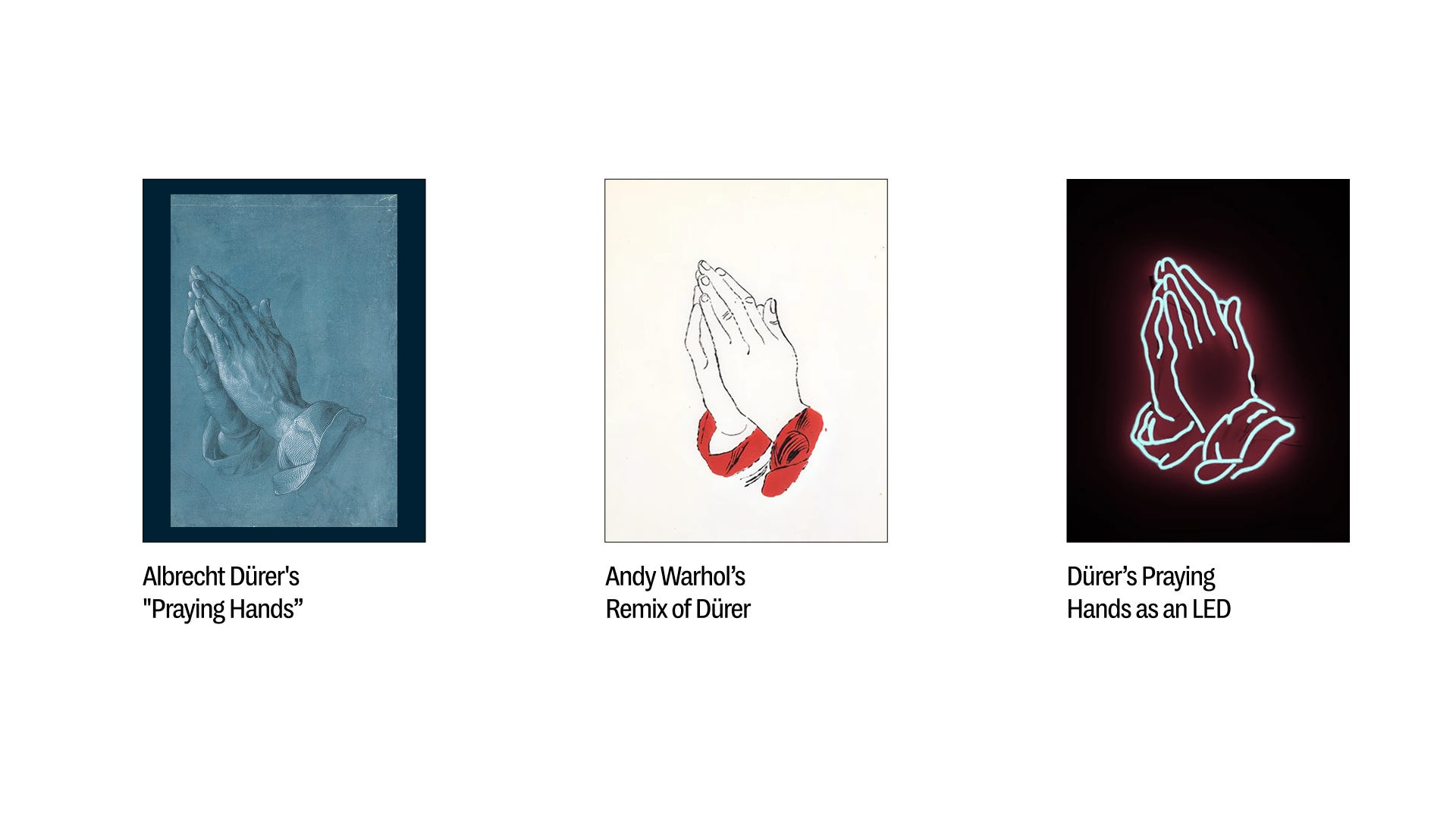
By the time these folded hands of submission reached your emoji keyboard in 2008, the icon was already carrying 500 years of Christian visual language. Which makes it all the more unexpected that the emoji itself actually had almost nothing to do with any of that.
A Japanese Gesture
Emojis obviously didn't emerge from Vatican vaults and you could be forgiven to think they were dreamed up at a Silicon Valley party. The emoji actually originated from the Land of the Rising Sun: Japan.
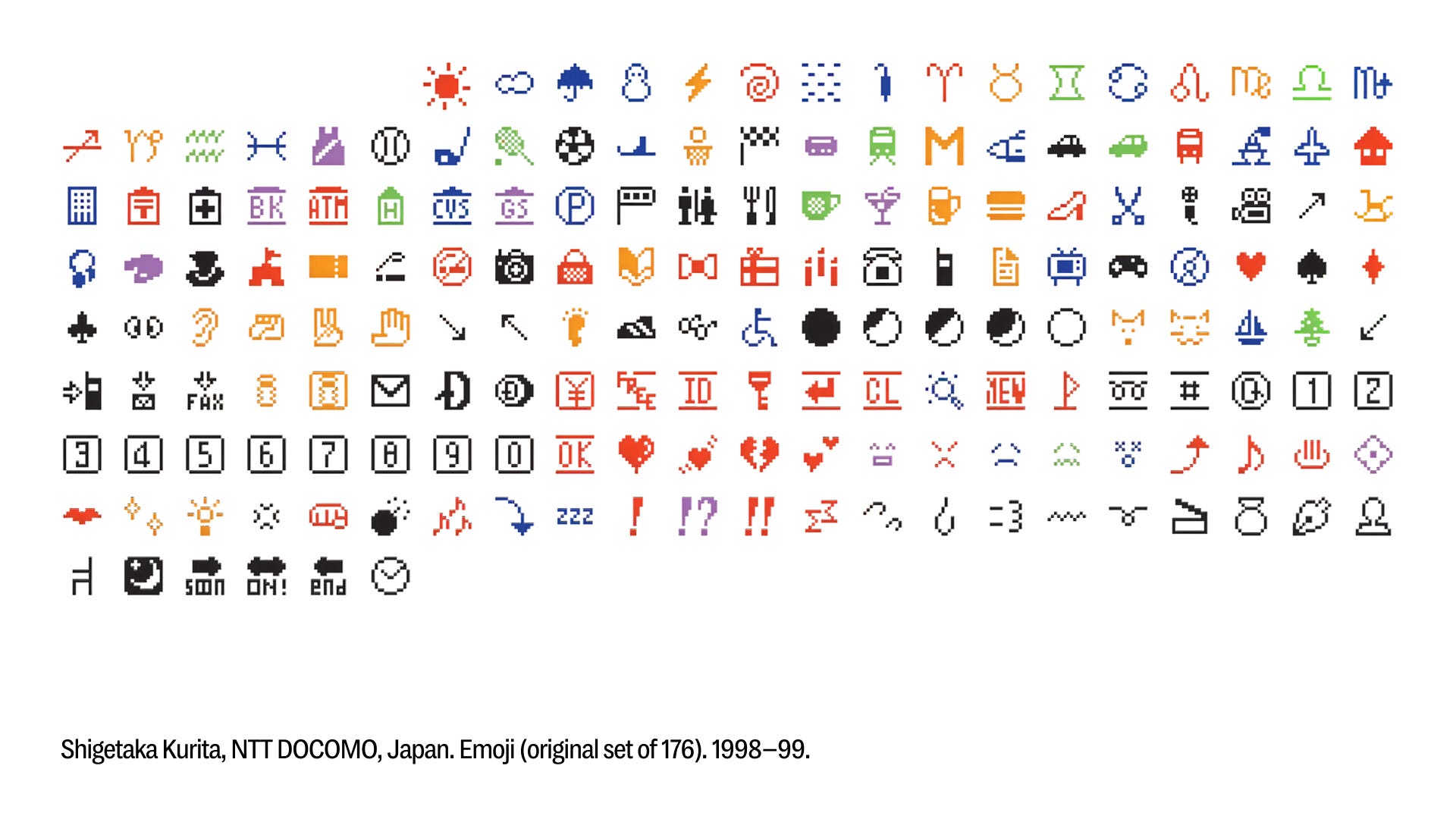
Japanese mobile carriers in the late 1990s are the father and mothers of the emoji — NTT DoCoMo’s i-mode service launched in 1999 with 176 tiny pixel icons, and rival carriers SoftBank and KDDI quickly built their own competing sets. Ultimately each collection had its own version of a folded hands ‘picture character’.
KDDI’s early design, from 2003, made the intent obvious — a full figure, head bowed, eyes closed. SoftBank’s was simpler: just the two hands. When the iPhone launched in Japan in 2008, Apple built its first emoji set directly on SoftBank’s designs effectively making it global, Google and Microsoft followed soon after.
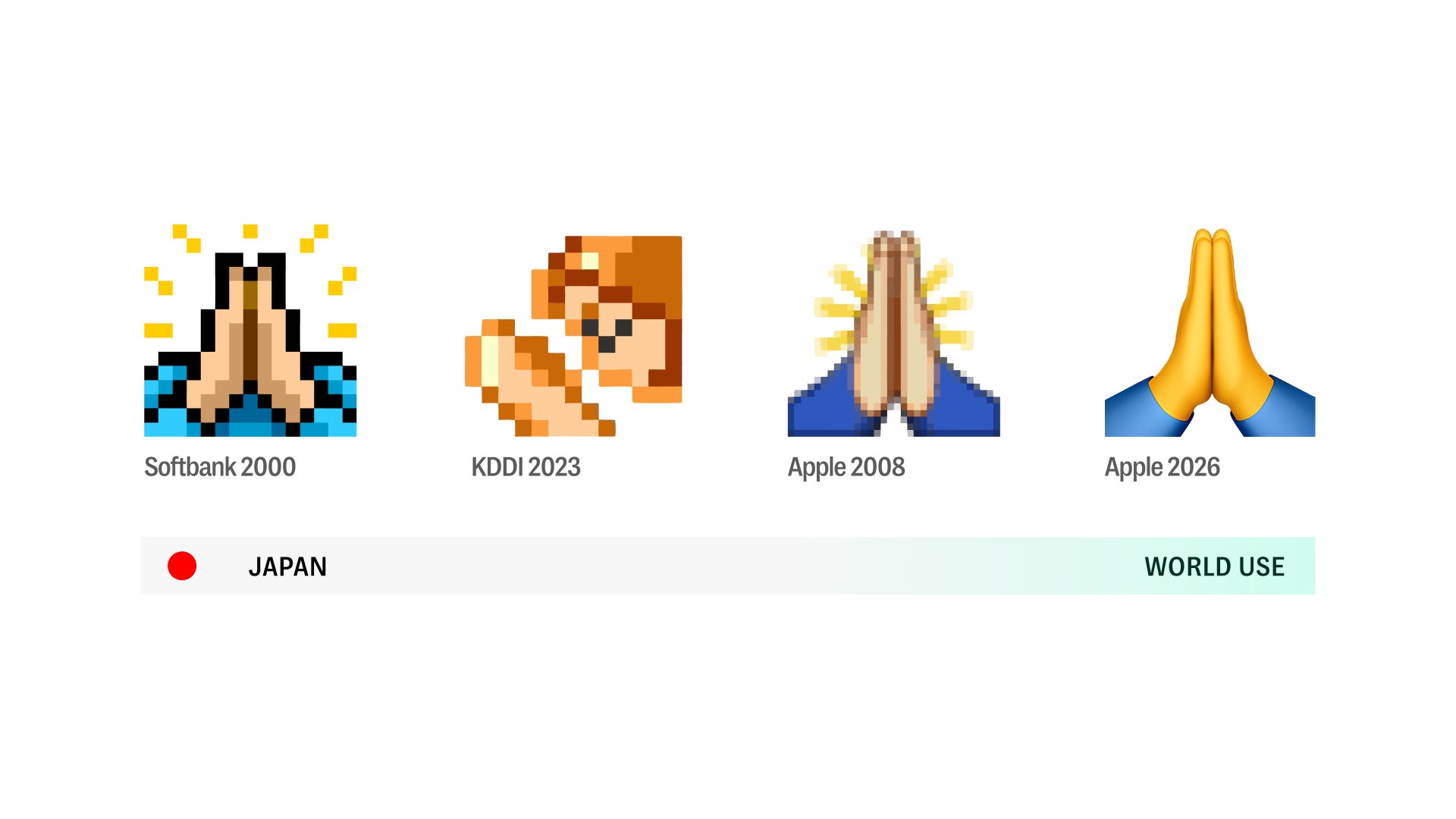
In Japan, this visual gesture was arguably never primarily about prayer. It’s the same gesture used before a meal, said alongside itadakimasu — closer to thanks than supplication. It is used when asking for forgiveness, of making a polite, insistent request or to show simple gratitude. It carries the same root as gasshō, the Buddhist bow of respect, and echoes the Hindu namaste — traditions of etiquette and reverence, not necessarily traditions of engaging a personal God.
When Unicode formally standardized the symbol in 2010, under the official name “Person with Folded Hands,” it inherited all of that ambiguity. Western users looked at two folded palms and immediately read it through a thousand years of Dürer living in the collective subconscious. Japan had handed the world a gesture of everyday respect and the world received it as a religious icon.
Nobody designed that meaning. It simply traveled by geographical osmosis — attached to a symbol whose original creators weren’t especially trying to say anything remotely about God at all.
All this history is a fun bit of tech trivia but it points to something worth sitting with.
Japan has one of the smallest Christian populations of any developed nation, and the history behind that is more dramatic than a lot of people know. Francis Xavier brought the gospel to Japan in 1549, and it established quickly enough that the response was severe: foreign missionaries were banned 38 years later, Christianity itself was outlawed in 1614, and widespread persecution followed until 1640.
A year later Japan sealed itself off from much of the outside world entirely, a period of national isolation that lasted until Commodore Perry forced its ports open in 1853. Protestant missionaries returned in 1859, but the ban on Christianity itself wasn’t formally lifted until 1873 — meaning Japan spent close to 260 years with the gospel officially outlawed. Religious freedom wasn’t constitutionally guaranteed until 1947, in the aftermath of the Second World War.
That history left a real mark. It’s a country where, as one member of the BibleProject Japan translation team put it, most people carry something close to a blank slate about the Bible. And the present-day church is under real strain: as of 2021, half of Japan’s pastors were 65 or older, seminary enrollment has been falling for years, and one in seven churches is without a pastor.
And yet quietly, patiently, something is stirring underneath.
Still Searching for the Shape of Prayer
Jeremy and Kumiko Jenkins, who lead 24-7 Prayer’s work in Japan describe it as work happening beneath the surface long before it’s visible above ground — the kind of growth, Kumiko writes, that takes years, the way “the strongest trees spend years growing beneath the surface before anyone notices them.”
They have been wondering what would it actually look like for prayer to arise authentically from the Japanese heart, rather than borrowed wholesale from outside Christian traditions that carry a very different spiritual history. Their answer points somewhere specific: Japanese spirituality has long moved through embodiment, space, and quiet rather than through decision and declaration. Which means the forms that will carry prayer authentically in Japan may look less like the American altar call and more like posture, gesture, stillness — categories Japan already has deep native fluency in and categories the Japanese mobile carriers were attempting to give visual language to in the late ‘90s.
Recently BibleProject Japan’s translation team ran into a version of the same challenge at the level of a single word. Rendering “the image of God” into Japanese, they landed on a phrase built around katachi — shape, form or pattern — “the shape of God” — reasoning that someone hearing it for the first time, with no biblical background, would land on roughly the right feeling even without the theological scaffolding. It’s a small, concrete example of a much bigger pattern: reaching for native form to carry meaning that originated somewhere else.
That same instinct — shape first, content later — is exactly what happened decades earlier with a gesture the whole world now uses several billion times a day.
Japan didn’t set out to give humanity its icon for prayer. It gave the world a shape — a form, a katachi — for something it associated with thanks, politeness, and everyday request. The world filled that shape with its own inherited meaning, layered on 5 centuries of Dürer founded on 15 more centuries of postured reverent submission.
Now, in a strange kind of symmetry, Japan finds itself doing the same work in reverse — searching for the language, the posture, the practice that would let prayer take root there as itself, not imported wholesale from elsewhere. And that search comes with a warning for anyone outside Japan tempted to treat this moment as a spectacle to admire from a distance.
Toshiki Morikawa, a pastor in Osaka known as the Gospel Samurai, has been blunt about it: he’s watched people arrive chasing “revival clips” for social media and hype without any real intention to love the country long after the cameras stop, and his church now asks any outsider who wants to partner with them to fully submit to the local church rather than their own brand. His challenge cuts close to the bone for anyone drawn to this story from outside: “Are you committed to coming to Japan or are you committed to impacting Japan?”
The world adopted Japan’s gesture and filled it with meaning Japan never intended. It would be a strange kind of irony to watch Japan’s own search for authentic prayer and do the same thing again — projecting outside expectations onto a story that isn’t ours to write.
The world has been gifted Japan’s shape for prayer and Japan is still exploring what to fill it with. Maybe the truest posture for the rest of us is the posture of folded hands of submission and intercession. This is really what Japan needs right now — to actually pray, and mean it, when we type 🙏.